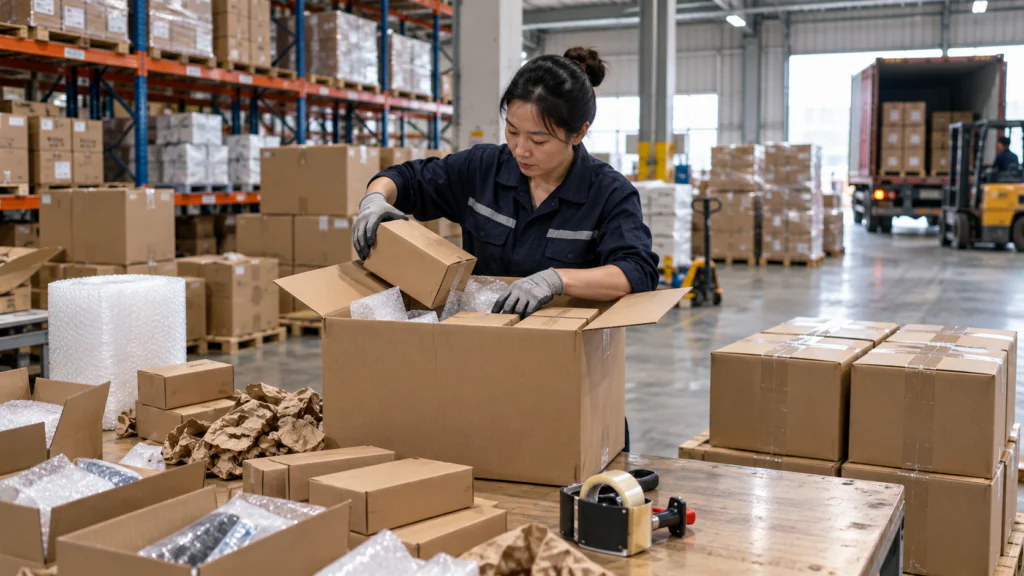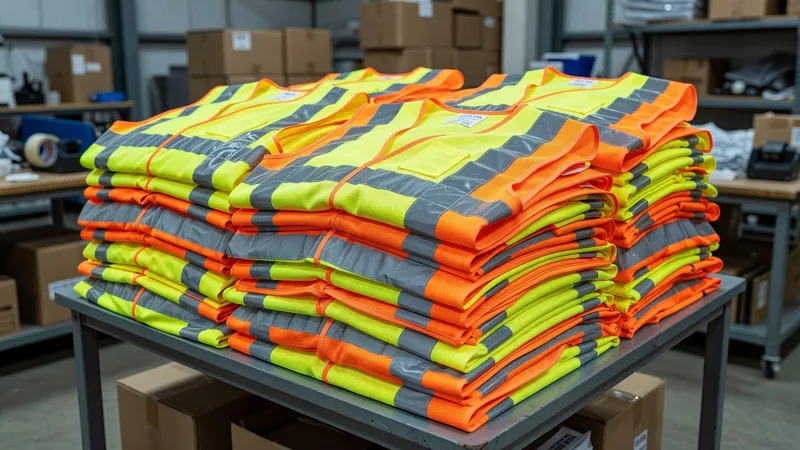
When a shipment of hi-vis workwear leaves the factory, the cartons do a quiet but important job. They protect the garments on a long sea or air journey, tell the warehouse team what is inside, and help customs clear the goods without delay. Poor packing and unclear carton marks cause more trouble than most buyers expect: crushed reflective tape, mixed sizes that are hard to sort, and cartons that cannot be identified at the destination port.
Choose the Right Carton
Start with a carton that fits the contents. A box that is too large lets garments shift and crease in transit; a box that is too small gets overfilled, and the tape or stitching can split under pressure. For folded vests and T-shirts, a standard five-ply export carton is usually strong enough for sea freight. Heavier items such as winter jackets and coveralls need a sturdier box that can carry the weight of the boxes stacked above it.
Always use new cartons for export orders. Reused boxes have already lost some of their strength, and a damp or weakened carton can collapse under a full container load.
Pack by Size and Style — Never Mixed
Each carton should contain one style, one colour, and one size, or a clearly recorded size run. Mixed cartons slow down everyone at the other end: the warehouse team has to open every box to find the sizes they need, and a counting error becomes much harder to trace.
A common method is to pack one size per carton and write the size on the carton mark — for example, 50 pieces of size L in carton 1 and 50 of size XL in carton 2. If sizes must share a carton, separate them with a sheet of paper and list the exact breakdown on the packing list. What is inside should be obvious without opening the box.
Protect the Reflective Tape Inside the Carton
Reflective tape is the most fragile part of a hi-vis garment. Pack folded garments so the tape is not pressed into a sharp crease and does not rub against zips, buckles, or rough fabric. Place a layer of tissue paper between layers of folded garments to stop tape sticking to tape, and avoid packing garments with the tape facing outward against the carton wall.
Garments should be clean and completely dry before packing. Even a little dampness sealed inside a carton can cause mildew and odours by the time the container arrives.
What Every Carton Mark Should Show
A carton mark is the label printed or stencilled on the outside of the box — how the shipment is identified from the factory floor to the customer’s warehouse. A clear mark usually includes the buyer’s name or company mark, the product name or style number, the colour and size inside, the quantity per carton, the carton number (for example 1/20, 2/20), the gross and net weight, the country of origin if the destination market requires it, and handling marks such as “Keep Dry” or “This Side Up”.
Print the mark clearly, large enough to read from a short distance — small, faint text is almost as bad as no mark at all. If the buyer has a specific carton mark format, the supplier should follow it exactly, including the buyer’s own reference numbers or codes.
The Packing List: Your Shipment’s Identity Card
The packing list records every carton, its contents, weight, and measurements. Customs officers, freight forwarders, and the receiving warehouse all use it, so it must match the cartons exactly: the same carton numbers, quantities, total weight, and volume as the goods that actually leave the factory.
Before the container is sealed, count one carton at random and check it against the list — one carton checked well often catches an error that would be far more expensive to fix at the destination.
Palletising and Loading
If the shipment travels on pallets, stack cartons evenly with the heaviest boxes at the bottom and the marks facing outward. Shrink-wrap the pallet, but leave the marks visible — or add a copy of the main mark on the outside of the wrap. Inside a container, fill gaps at the top of a stack with dunnage or airbags: cartons that move in transit are cartons that arrive crushed.
Common Mistakes to Avoid
The mistakes we see most often are easy to prevent: overloading cartons to save on freight — a carton over about 20 kilograms is hard to handle and more likely to break; vague marks with only a style number and no size or quantity; and a packing list that does not match the actual shipment, which delays customs clearance and can lead to extra inspection charges. One more: shipping garments with no moisture protection on a long sea voyage. A simple polybag around each garment, or a liner inside the carton, adds little cost and protects against condensation.
A Quick Checklist Before Dispatch
Before the goods leave the factory, check: cartons are new and strong, each carton holds one style and size, the tape is protected, every mark is clear and complete, the packing list matches the cartons, and the pallets are wrapped with marks visible. Five minutes of checking now can save days of sorting, claims, and emails later.
Good packing is not complicated, but it is a real part of product quality: it protects the garments, speeds up handling at both ends, and shows the buyer that the supplier takes the whole order seriously — from the first stitch to the last carton.
For hi-vis workwear, safety vests, jackets, and work pants, contact SUM SAFETY at sa***@*******ty.com or visit www.SumSafety.com.